





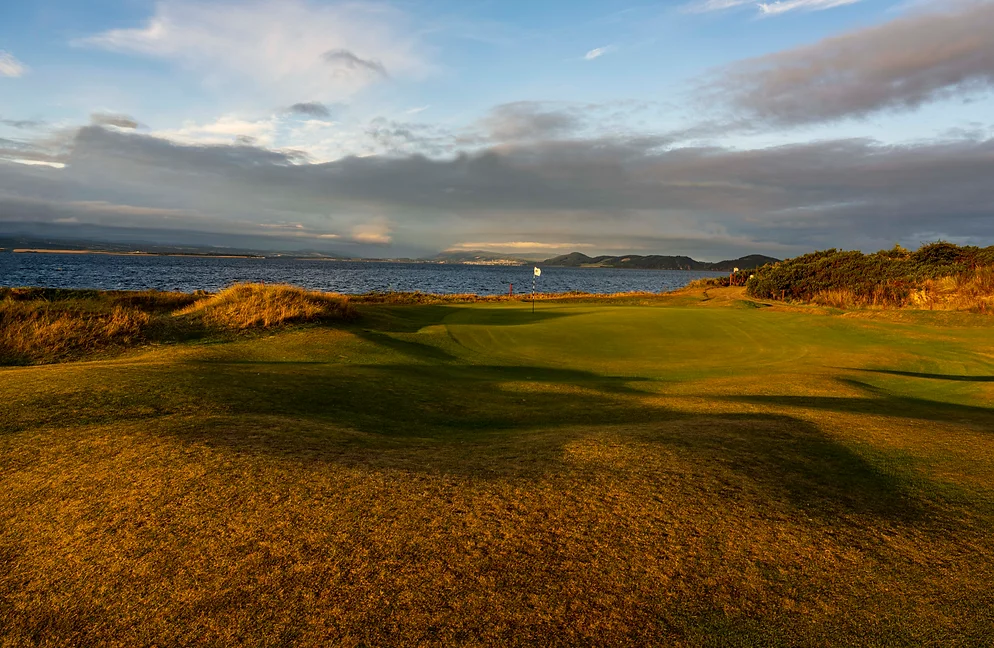
There are few places in the world where golf and landscape are so naturally intertwined as the Scottish Highlands. Here, a round of golf can take you from windswept coastal links beside the Moray Firth to heathland fairways beneath Ben Wyvis, from traditional seaside golf in Sutherland to pine-fringed parkland in the Cairngorms.
The Highlands offer something particularly attractive to the travelling golfer: variety. The region is not dependent on one famous championship course. Instead, it is a collection of distinctive clubs, each with its own character, history and scenery. Many have connections to some of the great names in golf-course architecture, particularly James Braid, whose influence can be traced across the region.
For golfers planning a Scottish trip, the Highlands provide an opportunity to combine outstanding golf with dramatic scenery, whisky, castles, fishing villages, mountains and some of the country’s most memorable driving routes. It is a destination where the journey between courses becomes part of the experience.
Why the Highlands are so good for golfers
The great attraction of Highland golf is its diversity. Along the coast, traditional links golf is shaped by wind, firm ground, dunes and the sea. Inland, courses wind through heath, woodland and mountain scenery, demanding a different style of play.
The area around Inverness is particularly useful as a base. From the city, golfers can reach a remarkable collection of courses without spending their entire holiday in the car. Muir of Ord and Fortrose & Rosemarkie are close by, while Nairn, Nairn Dunbar, Tain and Golspie can form part of a memorable Moray Firth itinerary. Travel further north and Brora offers one of Scotland’s most authentic James Braid links experiences. Head inland towards the Cairngorms and Boat of Garten provides a completely different Highland golfing environment.
There is also an important sense of history. Golf has been played in these communities for generations, with several clubs dating from the nineteenth century. At Fortrose & Rosemarkie, for example, there is documentary evidence of golf being played on the Chanonry peninsula as far back as 1702, while the club regards itself as the 15th oldest recorded golf club in the world.
This heritage gives Highland golf an authenticity that can be missing from newer golf destinations. You are not simply visiting a resort constructed for golfers; you are playing courses that grew out of their communities and landscapes.
Getting there – where should you fly?
For most golfers, Inverness Airport is the natural gateway to the Highlands. It is particularly convenient for an itinerary centred around Inverness, Nairn, Muir of Ord, Fortrose & Rosemarkie, Tain and the northern Moray Firth.
Nairn Dunbar, for example, specifically highlights Inverness Airport as being around 10 miles from the club, while the wider Nairn area is readily accessible from the airport.
A hire car is highly recommended. Although some towns are connected by rail and bus, having your own transport gives golfers the freedom to build a flexible itinerary and explore the spectacular roads linking the courses.
Aberdeen International Airport is another possibility, particularly for golfers combining the Highlands with Aberdeenshire or travelling north towards Sutherland. Aberdeen currently has a broad network of domestic and international connections, including Dublin, London, Manchester, Amsterdam, Paris, Copenhagen, Bergen and several Spanish and Mediterranean destinations.
For an extended northern trip, Aberdeen can even connect with Wick, providing an option for reaching Caithness and Sutherland.
For most golf holidays, however, Inverness remains the most logical starting point.
Muir of Ord – James Braid golf in the heart of the Highlands
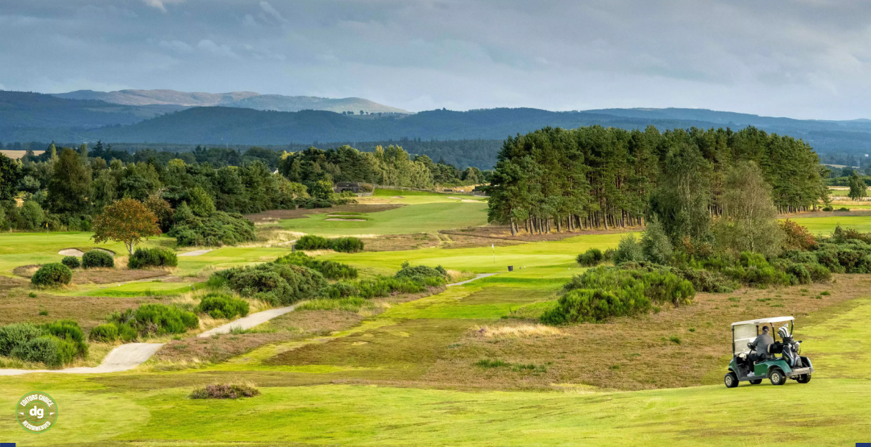
Muir of Ord Golf Club is one of the Highlands’ most enjoyable hidden gems. Situated around 11 miles from Inverness, the club occupies an intriguing heathland and moorland setting with views towards Ben Wyvis and the Beauly Firth.
The club’s history stretches back to 1875, when its original nine-hole course was established. As golf grew in popularity, the members wanted more, and in the 1920s the legendary James Braid was invited to create the additional nine holes. The extension opened in 1927 and much of Braid’s work remains evident today.
The course is wonderfully individual. The Inverness-to-Wick railway line actually crosses through the layout, creating a feature that is as memorable as it is unusual.
The standout hole is the 12th, ‘Thirsty’, a demanding par three of around 219 yards from the white tees. Two burns cross the hole, and the club recommends taking one club less than normal while favouring the right side of the green.
After golf, the clubhouse provides exactly the sort of welcome a visiting golfer wants, with a bar, lounge, restaurant and the Albatross Restaurant serving breakfasts, snacks and hearty meals. There is also a golf shop, equipment hire, buggies and changing facilities.
Muir of Ord is a superb opening round for a Highland golf trip: historic, friendly, unusual and thoroughly Scottish.
BOOK NOW Muir of Ord Golf Club – Award Winning 18 Hole Heathland Course
Fortrose & Rosemarkie – links golf surrounded by the sea
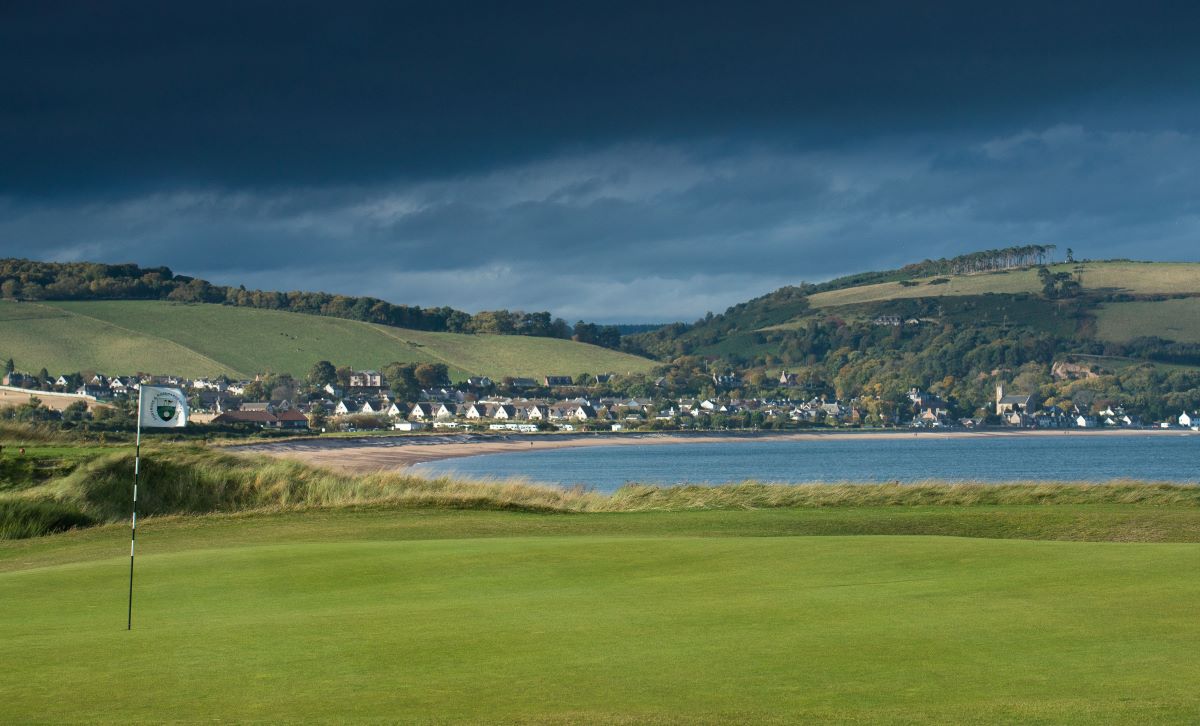
Fortrose & Rosemarkie Golf Club may be one of the most atmospheric courses in the Highlands. Sitting on the Chanonry Peninsula of the Black Isle, the course is almost surrounded by water, with the Moray Firth providing a spectacular backdrop.
Golf’s history here is extraordinary. The club traces recorded play back to 1793, although evidence of golf in the area dates to 1702. The present club was formally established in 1888. A clubhouse followed in 1895, and the course eventually developed into 18 holes.
The course was redesigned by James Braid in the 1930s, with his recommendations forming the foundation of the layout played today. His trademark strategic bunkering and tight fairways remain part of its character.
The 4th hole is the signature challenge: a long par five with a two-tier fairway and the option to attack aggressively or play more conservatively. The approach bends towards a green dominated visually by Chanonry Lighthouse, making it one of the most memorable holes in Highland golf.
The club has endured wars, military occupation and major changes to its facilities. Its clubhouse was damaged during both World Wars, while the course itself was requisitioned during the Second World War for military training connected with preparations for the D-Day landings.
Today, the club offers visitors a warm welcome and the chance to enjoy one of Scotland’s oldest golfing environments, with spectacular Moray Firth scenery and even the possibility of seeing bottlenose dolphins close to the course.
BOOK NOW Fortrose Golf Links, 15th oldest golf course in the world – Fortrose and Rosemarkie Golf Club
Golspie – where links meets heathland
Golspie Golf Club provides perhaps one of the most interesting combinations of terrain in Highland golf. Situated on the northeast coast between the sea and the slopes of Ben Bhraggie, the course combines links, heathland and parkland characteristics.
The club was founded in 1889, following earlier golfing activity in the area. The original nine-hole course was extended to 18 holes in 1905, and James Braid later made important improvements, completed during the 1920s.
The result is a wonderfully varied round. Golfers move through changing landscapes rather than playing essentially the same terrain for 18 holes. Sea and mountain views are constant companions.
One of the memorable features is the transition towards the seaside holes, where the links character becomes increasingly obvious. The closing stretch also includes back-to-back par threes, creating a fine test of accuracy late in the round.
The clubhouse is an important part of the Golspie experience. Visitors can enjoy a well-stocked pro shop, putting green, practice nets, catering from breakfast through to substantial post-round meals, and a fully stocked licensed bar.
For golfers travelling the North Coast 500, Golspie is almost impossible to ignore. It combines scenery, history, affordability and architectural interest in one very enjoyable package.
Nairn Dunbar – traditional golf with a local spirit
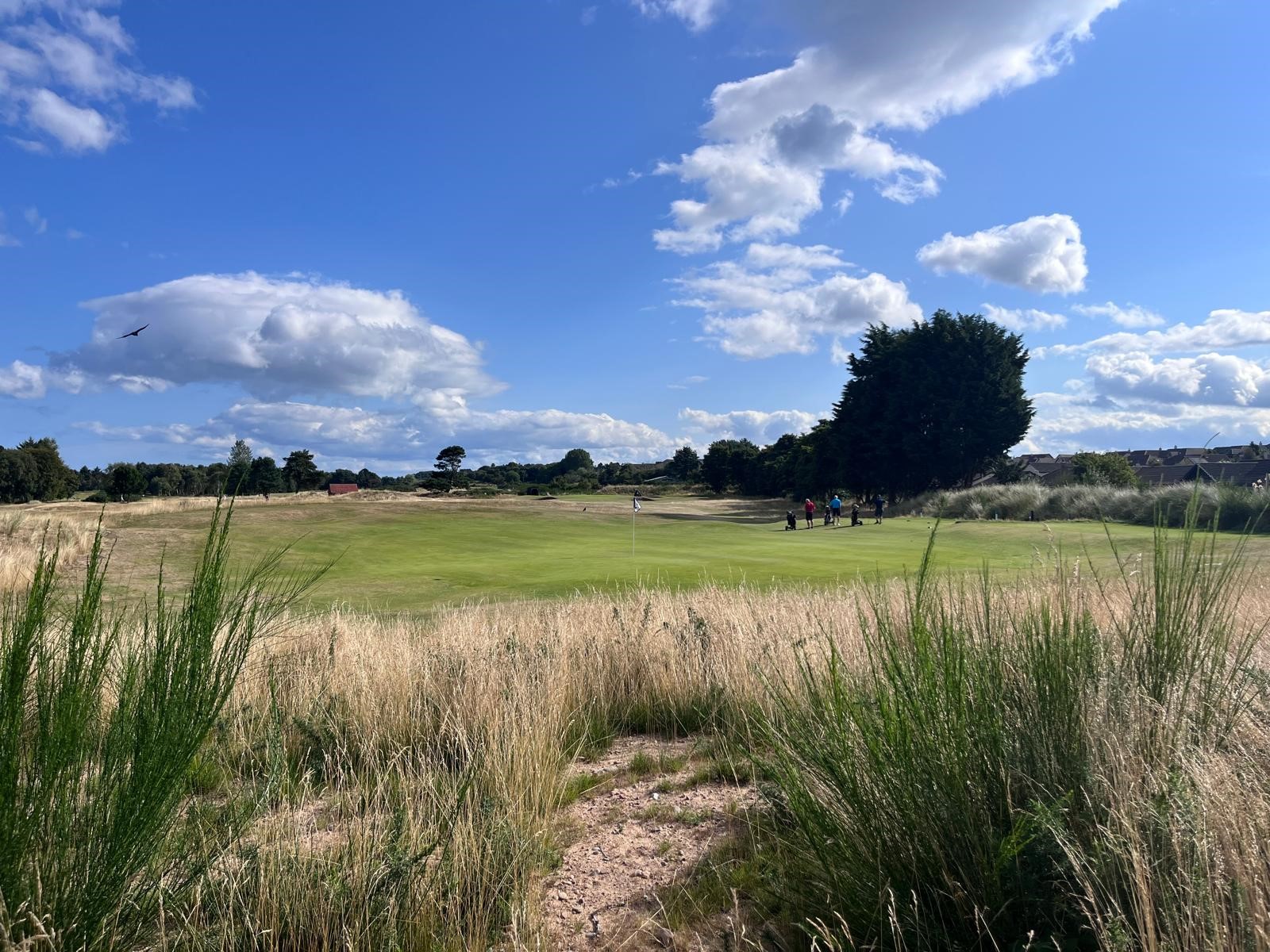
Nairn Dunbar Golf Club is located on the eastern side of Nairn and provides a different experience from its famous neighbour, Nairn Golf Club.
The club was founded in 1899, when Sir Alexander Dunbar of Boath provided around 60 acres for a nine-hole course. Lady Dunbar officially opened the course on 24 May that year. The course eventually expanded to 18 holes, while major restructuring in the 1990s produced much of the layout golfers see today.
The current course was designed by local professional Peter Robertson in 1936, although the layout has subsequently evolved.
Nairn Dunbar has an interesting social history. While the neighbouring Nairn Golf Club was historically associated with wealthier members of society, the Dunbar course was established to give working people in Nairn an opportunity to enjoy golf. That community identity remains an important part of the club.
The course is now a substantial par-72 championship layout stretching to more than 6,600 yards, with firm fairways, dunes, heath and strategic bunkering. The 18th, a par five, is a particularly enjoyable finish, with the green sitting on a raised platform and offering a genuine opportunity for an ambitious approach.
The clubhouse is another strength. Its lounge offers extensive views over the course and towards the Moray Firth, while breakfast, lunch, snacks and hot and cold drinks are available. The professional shop and bar catering facilities make it a comfortable place to begin or finish a day’s golf.
BOOK NOW Nairn Dunbar Golf Club, Highlands, Scotland | Highland Links Course, Scotland
Brora – pure James Braid links
Brora Golf Club is one of the Highlands’ essential golf experiences.
The club was formed in 1891, initially playing over nine holes before expanding to 18. In 1924, James Braid visited and produced plans for a redesigned 18-hole course. Much of that work remains intact, giving Brora an unusually strong claim to being an authentic Braid links.
The course is natural, rugged and wonderfully understated. It is golf stripped back to its essentials: wind, turf, clever angles, natural hazards and strategic thinking.
The clubhouse overlooks the course and provides a warm Highland welcome after the round. Brora is also closely associated with the James Braid golfing tradition and remains one of the finest examples of his work in the Highlands.
Tain – Old Tom Morris in the Highlands
Tain Golf Club, on the shores of the Dornoch Firth, offers something rather special: genuine surviving golf architecture from Old Tom Morris.
Morris laid out the original course in 1889, initially producing 15 holes because of the land available. Additional land was later acquired and the course was developed into a full 18-hole layout. The club adopted the name Tain Golf Club in 1911, while the clubhouse was rebuilt in 1998.
Several holes still retain elements of Morris’s original work, including the 2nd, 3rd, 4th, 6th, 9th, 10th, 14th and 15th. That makes Tain particularly fascinating for golfers who enjoy the architectural history of the game.
The course combines links and heathland and stretches to around 6,400 yards, with views over the Dornoch Firth. The clubhouse is deliberately welcoming and informal, with a cosy atmosphere, bar and professional shop.
Boat of Garten – Highland golf among the pines
Boat of Garten Golf & Tennis Club provides a complete change of scenery.
Known affectionately as “The Boat”, the course sits beside the River Spey in the Cairngorms National Park, around ten minutes from Aviemore. Founded in 1898, the original course was expanded to 18 holes by James Braid in the early 1930s.
Here, the golfer trades sea views for mountain panoramas, Caledonian pine, birch, heather and broom. Braid created 18 individual holes that make intelligent use of the natural landscape.
The 13th, Tulloch, is a memorable par five and one of the course’s standout holes, requiring good strategic decisions throughout the hole.
The club’s setting in the Cairngorms makes it an ideal addition to a Highland itinerary, particularly for golfers who want to combine links golf with a scenic inland round.
The wider Highland golf itinerary
These seven courses only begin to reveal the choice available. Golfers can also add the famous Nairn Golf Club, with its championship links and remarkable competitive history, including the Walker Cup and Curtis Cup. The wider Inverness and Moray Firth area provides an exceptional concentration of golf, while Royal Dornoch remains the obvious pilgrimage for golfers travelling further north.
For a longer trip, the Highlands can therefore be divided into sections: Inverness and Nairn, the Black Isle and Easter Ross, the northern coast around Golspie and Brora, and the Cairngorms around Boat of Garten.
Each area feels different.
The perfect Highland golf trip
What makes the Highlands such an appealing golf destination is not simply the quality of individual courses. It is the sense of discovery.
One day you can play a James Braid heathland course at Muir of Ord; the next you can stand beside the Moray Firth at Fortrose & Rosemarkie. You can experience the changing terrain of Golspie, the community character of Nairn Dunbar, the rugged authenticity of Brora, the Old Tom Morris heritage of Tain and the mountain setting of Boat of Garten.
Few golf destinations can offer such a mixture of architects, landscapes and golfing traditions within one region.
Add in Inverness, the North Coast 500, the Cairngorms, Highland whisky, castles, mountains, beaches and the warm hospitality of the local clubs, and the Highlands become much more than a golf destination.
So much choice and variety of courses in the area makes the Highlands an ideal place to go for your next golf trip.