




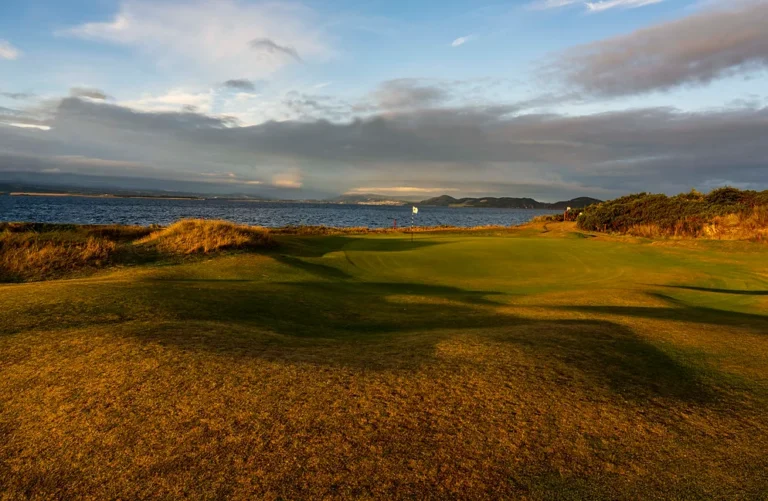
In Ireland’s western province, golf is inseparable from landscape. Across Galway, Mayo, Sligo, Leitrim and Roscommon, the Atlantic, mountains, dunes, bogland and weather combine to create a golfing experience that feels less manufactured and more discovered.
There is a moment on the west coast of Ireland when the road seems to run out.
The towns become smaller. The hedgerows give way to bog and stone walls. The Atlantic appears beyond a rise in the road, and suddenly the landscape becomes enormous.
This is Connacht.
Comprising the five counties of Galway, Mayo, Sligo, Leitrim and Roscommon, the province occupies a special place in Irish golf. Its best-known courses are not simply golf courses imposed upon beautiful landscapes. They are products of those landscapes: holes routed through dunes, around rocky outcrops, across linksland shaped by wind and sea.
The result is golf that can be exhilarating, frustrating, spectacular and profoundly natural — sometimes all within the same round.
And there is another attraction. Connacht still feels like a journey. The region’s great links are spread across the western seaboard rather than clustered around a single resort destination. That means a golfing trip here becomes a road trip, with Sligo’s mountains, Mayo’s remote Atlantic coast and Galway’s Connemara landscape providing as much drama between rounds as there is during them.
Tourism Ireland describes the region’s principal links — including Carne, Enniscrone and Connemara — as among the outstanding golfing experiences along the Wild Atlantic Way.
For the travelling golfer, this is the appeal: Connacht doesn’t merely offer golf beside the Atlantic. It offers golf that feels created by the Atlantic.
CARNE GOLF LINKS — MAYO’S WILD SIDE
Of all the golf courses in Connacht, few capture the character of the province more completely than Carne Golf Links.
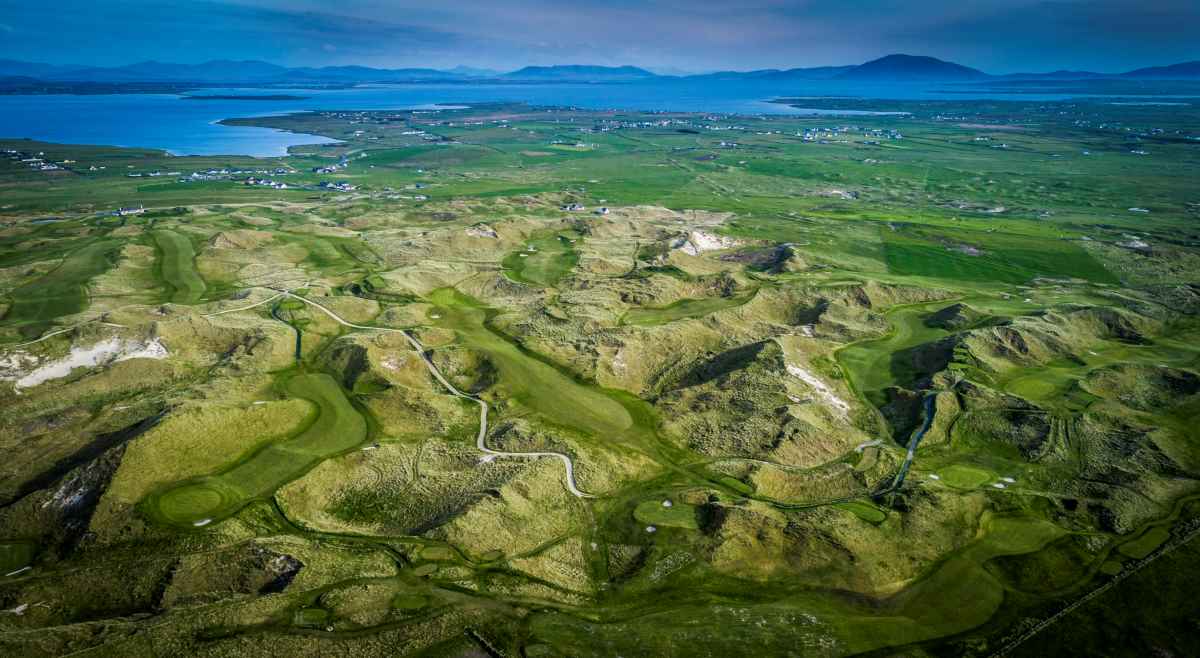
Located near Belmullet on the Mullet Peninsula in north-west Mayo, Carne is remote in precisely the way a great links should be remote. The landscape is vast, windswept and almost completely uninterested in whether you make par.
The original 18 holes were designed by the legendary Irish architect Eddie Hackett, whose philosophy was to work with the land rather than reshape it. Carne was his final course and is frequently regarded as one of his finest achievements. The club’s original course required remarkably little earth moving; tees and greens were located largely where the natural contours suggested they should be.
Then came the extraordinary dunes.
A further nine holes were created in 2013 by Ally McIntosh and Jim Engh, based on Hackett’s original vision and sketches for the most dramatic section of the property. Those holes were subsequently integrated with Hackett’s back nine to create the Wild Atlantic Dunes routing, which launched in 2020.
It is difficult to describe the scale of the dunes until you are standing among them. They rise dramatically above the fairways, creating blind shots, elevated greens and enormous changes of elevation.
The feature hole is less about a single conventional signature hole than the extraordinary sequence through the highest dunes. The 10th and the holes that follow it provide the quintessential Carne experience, with the golfer climbing into a landscape that feels more like a natural amphitheatre than a conventional golf course.
The club now offers two distinct championship routings, meaning the serious visitor should consider playing both rather than treating Carne as a one-round stop.
The clubhouse is deliberately understated, matching the character of the place. This is not golf theatre; it is a warm, traditional clubhouse where the emphasis is on hospitality, food, drink and recounting the day’s battles.
And there is a good reason to linger.
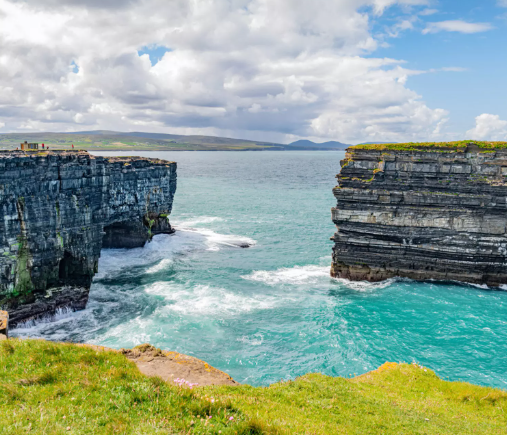
Don’t miss: the wider Erris region. Visit Downpatrick Head, see the spectacular sea stack of Dún Briste, explore the Céide Fields and take time around Blacksod Bay. Mayo’s coastline is one of Ireland’s great wilderness experiences, while Wild Nephin National Park provides another opportunity to experience the county away from the fairways.
Carne is golf for those who want to feel that they have genuinely gone somewhere.
ENNISCRONE — WHERE THE DUNES TAKE OVER
If Carne is wild, Enniscrone Golf Club is exuberant.
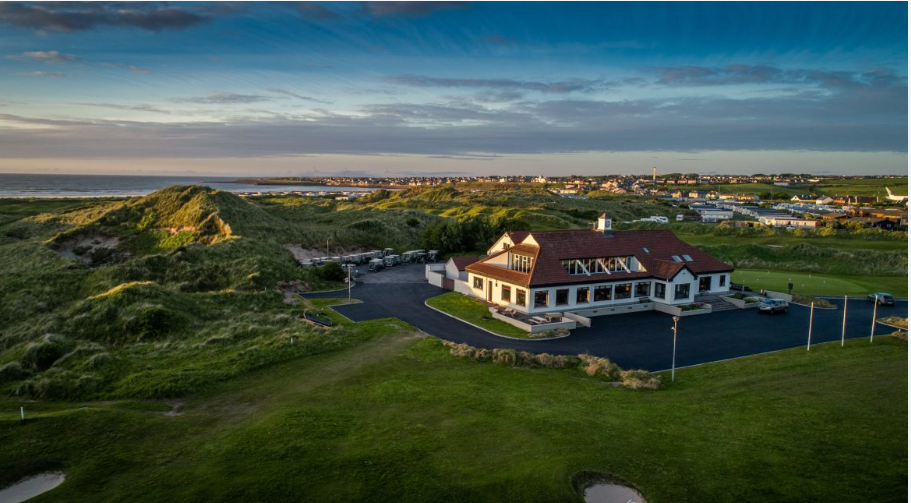
The club, on County Sligo’s Atlantic coast, occupies a magnificent stretch of linksland where enormous dunes dominate the landscape. It has 27 holes, comprising the championship Dunes course and the shorter Scurmore nine.
The story of the course begins with Eddie Hackett, who worked on the links during the early 1970s. His original 18 holes opened in 1974. But the course’s modern character owes much to Donald Steel, who was commissioned in the late 1990s to take the layout directly into the dramatic dune system. Steel added six new holes through the dunes and created three further holes for the Scurmore nine. The renovated course opened in 2001.
What Steel discovered was almost too good to believe.
The dunes are enormous, creating corridors and blind approaches, steep run-offs and hidden hollows. As LINKS Magazine has noted, the dunes dominate the golfing experience, creating a labyrinth of strategic challenges.
One of the most memorable stretches comes as the course climbs into this dune country. Rather than a single postcard hole, Enniscrone’s signature is the succession of holes through the great sand hills, where every tee presents a new visual problem.
That is the magic of links golf: the question is not simply “Where is the pin?” but “Where is the hole?”
The clubhouse provides a welcome contrast to the wildness outside. Its restaurant offers breakfast, lunch and dinner, with bar and restaurant facilities suitable for visiting groups and societies.
There is also the considerable advantage of having 27 holes: golfers can experience the championship Dunes course while retaining the option of a second, more relaxed round on Scurmore.
Don’t miss: Sligo town, the home of W.B. Yeats, and the extraordinary landscapes around Benbulben. Continue towards Mullaghmore Head, or explore the county’s surfing culture. Enniscrone itself is a seaside resort with a long strand and a distinctly relaxed atmosphere.
For golfers travelling north or south along the Wild Atlantic Way, Enniscrone is an essential stop.
CONNEMARA GOLF LINKS — GOLF AT THE EDGE OF GALWAY
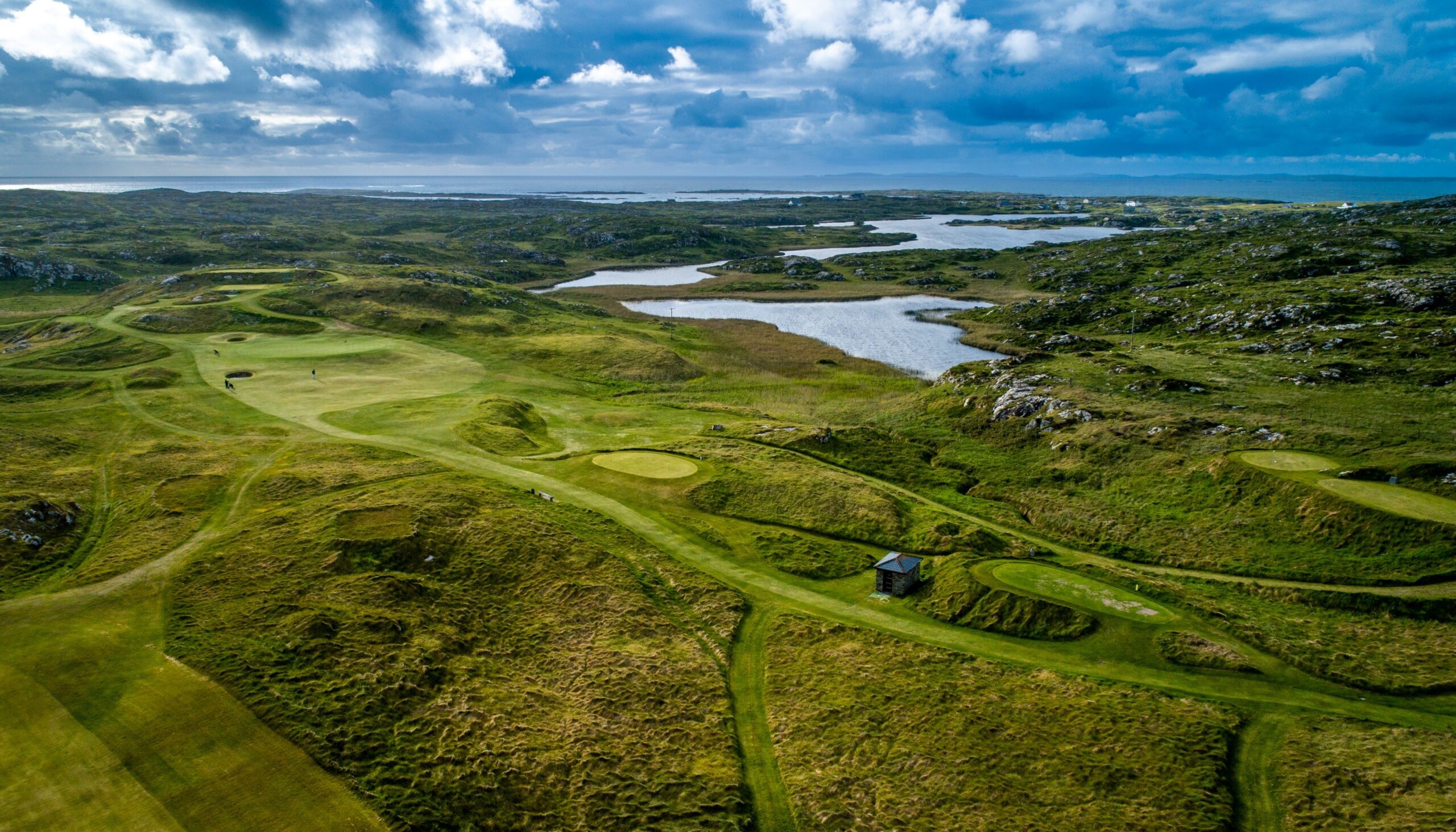
Few golf courses feel as isolated as Connemara Golf Links.
West of Clifden at Ballyconneely, the course occupies an extraordinary piece of Galway coastline close to Mannin Bay and the Wild Atlantic Way. It celebrated its 50th anniversary in 2023.
The course was designed by Eddie Hackett, and once again the architect’s philosophy was to allow the land to dictate the golf.
There are no enormous artificial earthworks here. Instead, the golfer encounters rocky ground, coastal vegetation, natural contours and, above all, the wind.
Connemara is a 27-hole facility, with the championship layout forming the principal attraction. Tourism Ireland describes it as one of the tougher championship courses in the region, noting that its relatively open terrain leaves the golfer exposed to the wind and provides panoramic views of the coast and mountains.
The 12th hole is widely highlighted as a signature moment: a dramatic par three in which wind, natural surroundings and the Atlantic combine to make club selection critical. The course itself also identifies several spectacular viewpoints, including its signature-hole area, while the 11th and 12th provide one of the property’s most memorable visual sequences.
But perhaps the most compelling thing about Connemara is what happens when the weather changes.
A hole you played in a gentle breeze in the morning can become an entirely different proposition when the Atlantic wind turns. That is links golf in its purest form.
The modern clubhouse provides everything the visiting golfer needs: restaurant and bar, changing rooms, showers, Pro Shop, club rental, trolleys, buggies, caddies by advance booking, practice areas and PGA coaching. The restaurant uses local produce and offers panoramic views across the surrounding landscape.
And then there is the setting.
Don’t miss: Clifden, the unofficial capital of Connemara; Kylemore Abbey; the Twelve Bens; Sky Road; and the beaches around Ballyconneely and Roundstone. The region’s Connemara ponies, blanket bogs, stone walls and tiny coastal roads are as much a part of the destination as the golf. Galway tourism highlights the area’s beaches, bogland, islands and distinctive pony culture as some of its defining experiences.
MORE THAN THREE COURSES
For a destination feature, it would be easy to concentrate entirely on the three great links at Carne, Enniscrone and Connemara.
That would, however, miss the point of Connacht.
The province’s character comes from the spaces between the courses.
Galway provides the cultural gateway. Galway city combines medieval streets, restaurants, music and a famously energetic atmosphere, while the road west rapidly transforms into Connemara’s granite, bog and Atlantic wilderness.
Mayo is perhaps the most elemental of the five counties. Its coastline includes Achill Island, Clew Bay, Croagh Patrick, Downpatrick Head and the remote Erris peninsula. The county has Ireland’s longest coastline and some of the country’s most dramatic coastal scenery.
Sligo is the county of mountains and poetry. Benbulben dominates the skyline, while the legacy of Yeats gives the landscape an additional cultural dimension. Add surfing, beaches and excellent seafood and there is little reason to head straight back to the hotel after golf.
Leitrim offers a completely different mood. Inland waterways, lakes and countryside replace the immediate drama of the Atlantic. It is ideal for slowing the itinerary down, with the Shannon-Erne waterway and rural landscape offering a gentler counterpoint to the links.
Roscommon, likewise, provides the inland heart of Connacht: lakes, historic sites, forests and traditional towns. For the travelling golfer, it can form part of a longer itinerary between the western links and Ireland’s midlands.
This variety is precisely why Connacht works so well as a golf destination.
THE WILD ATLANTIC GOLF EXPERIENCE
There is a temptation when discussing Irish golf to concentrate on rankings.
Connacht makes that approach feel rather inadequate.
The great pleasure here is not simply whether a course appears at a particular position on a list. It is the sensation of standing on a tee with an Atlantic wind moving across the dunes, knowing that the architects — Hackett, Steel, McIntosh, Engh — have largely resisted the temptation to tame the landscape.
This is golf that rewards imagination.
The ground game matters. Wind direction matters. The bounce matters. Positioning matters. And sometimes the best strategy is simply to accept that nature is going to have the final word.
The Wild Atlantic Way itself reinforces the experience. The 2,500-kilometre coastal route runs through Galway, Mayo, Sligo and Leitrim, connecting remote beaches, villages, historic sites and spectacular coastal landscapes.
For a golfer, that creates an itinerary with almost no wasted miles.
Play Connemara, then explore Clifden.
Drive north through Mayo, play Carne, and discover the remote Mullet Peninsula.
Continue into Sligo, play Enniscrone, and finish the day beside Benbulben or on the beach.
And don’t rush.
Because the great attraction of Connacht is that the golf never feels separate from the destination.
The road, the weather, the pub, the seafood, the music, the mountain and the Atlantic are all part of the same experience.
In an era when golf travel increasingly gravitates towards polished resorts and carefully packaged experiences, Connacht offers something rather different.
It offers discovery.
And for the golfer prepared to drive west until the road almost disappears, that may be its greatest luxury of all.
READ MORE ON CONNACHT IN THIS YEAR’S; DESTINATION GOLF IRELAND TOP150